Showing posts with label telepractice. Show all posts

Friday, July 31, 2020

Telepractice Checklists

For 5 months, implementers of the Routines-Based Model (RBM) have been noting how relatively easy the switch to virtual visits has been, especially for home visits. Because Routines-Based Home Visits have always been centered on collaboration with the caregiver, we simply switched from sitting in the living room together to talking via Zoom. The biggest difficulty has obviously been the small amount of time the home visitor might have been interacting directly with the child. I have always said there are three reasons to put your hands on a child:

  • ·       Assessment (seeing what a child might do with a certain strategy)
  • ·       Demonstration (showing the family what your strategy looks like)
  • ·       To show you love the child.

In telepractice, we can’t do these in the same way, with literal hands on, but “home visitors” have devised creative ways to have caregivers show what the child does (assessment) and to be explicit about their ideas (the equivalent of demonstration).

The RBM has always used performance checklists to (a) describe practices in the model, (b) serve as a platform for feedback in coaching, and (c) measure the fidelity to the model of a professional’s practice (Dunst & Raab, 2010; Marturana & Woods, 2012). We have therefore created the Routines-Based Telepractice Visit Checklist and the Telepractice Collaborative Consultation to Children’s Classrooms (CC2CC) Checklist. You can find these at www.eieio.ua.edu/materials under Consultative Service Delivery.

Routines-Based Telepractice Visit Checklist

We were able to use the Routines-Based Home Visit Checklist as the basis for this telepractice version. The new one has a section on establishing a technology connection. It also recognizes that the pandemic, the lockdown, early intervention delivered through telepractice, working from home, and so on, demand extra sensitivity and empathy from the home visitor.

We still review child goals, if that’s what the family wants to talk about, going over existing strategies the family has been using or developing new strategies. One of the hallmarks of the RBM is the collaborative approach with caregivers, which, with families, we call family consultation. We do not simply listen to a family’s report or concern and immediately give them suggestions: That would be an expert model, not a collaborative model. In telepractice visits, it’s the same: We ask many questions before venturing an idea.

If demonstration by the home visitor would be helpful, telepractice challenges us. On the checklist, we have added describing the strategy in detail to demonstration (Item 25). Whereas on a live visit, the home visitor might describe the strategy in fairly general terms, followed by, “Would you like me to show you what I’m talking about?” the virtual visit cannot rely on showing the family what you’re talking about. For example, the home visitor might say, after asking many questions to get context, “Have you considered sitting behind him on the floor and applying gentle pressure on his hips to stabilize him?” After the parent’s quizzical look, the home visitor says, “Would you like me to show you?” Now, in a telepractice visit, the home visitor might still suggest the pressure on the hips and, instead of offering to demonstrate, say, “Would you like me to be more specific?” If the parent says yes, the home visitor continues, “You can sit behind him, with him sitting between your legs. He should have things to do in front of him—toys he likes, for example. To help him be stable, you can put your hands at the tops of his legs, with gentle pressure. That should stabilize him. Over time, you can release that pressure, to give him opportunities to stabilize himself, using his core.” This can be accompanied by demonstrating on yourself, about the placement of hands, for example. Some home visitors are using dolls as props for demonstration.

Just like in-person home visits, when you conduct a visit virtually, you should have the Next-Steps Form, the ecomap, and the matrix. These can all be found at www.eieio.ua.edu/materials. These are the three key documents a home visitor using Routines-Based Home Visits has at every visit. In the virtual world, we still use them.

Just like in-person visits, virtual visits take advantage of the opportunity to provide emotional, material, and informational support, as needed. They also take advantage of the opportunity to attend to parenting basics, which, in our model, are talking to children, reading to children, playing with children, and teaching children. We say in the RBM that early intervention is a parenting program, not a rehabilitation or special education program.

Telepractice CC2CC Checklist

Visiting teachers, virtually, is a tricky business. Some classrooms are open to accommodate the needs for child care of essential workers. Our useless federal leadership is telling us contradictory and scienceless noninformation about how to meet the needs of children in classroom programs. This situation has revealed much about the strengths and weaknesses of governors, even within the two major parties. In our field, we have to recognize that some infants, toddlers, and preschoolers with disabilities are going to classrooms, and we early interventionists (I include in this term early childhood special educators and therapists) need to support their teachers, without visiting the classrooms in person.

Hence, we have developed the Telepractice CC2CC Checklist as a guide. I hope, in some programs, coaches are joining the visits to classrooms, and providing feedback, using the checklist. If not, visitors (i.e., “home visitors” going to child care, itinerant ECSEs) can check themselves.

Again, we did not have to make many changes to our CC2CC Checklist. The same issues discussed in virtual home visits are pertinent in classroom visits, so I won’t repeat them here. In in-person visits as well as in telepractice visits with teachers, we do want to include classroom-wide issues, such as the zone defense schedule, using incidental teaching, and using ideas from Reggio Emilia (see Item 31).

With both Routines-Based Telepractice Visits and Telepractice CC2CC, we should keep the following in mind.

  1.   Visits might be shorter because of distractions, interruptions, and videoconference fatigue.
  2.     Visits might seem disjointed and disorganize; give yourself a break—you have less control over the situation.
  3. Families might be distracted, uninterested in your visit, or inconsistent in their reports; give them a break—we don’t know everything they’re dealing with, although you should try to find out and understand.
  4. Some families might be thriving in this environment. They love being home with their kids and don’t want to be out with other people.
  5.   Teachers in classrooms are true front-line workers. I hope people put up signs saying “Heroes work here,” like they do at hospitals. These teachers are under more stress than usual. Maybe your work is to reassure them, give them a laugh, and maybe help them with some difficult situations.

I hope the checklists help. Thanks to Cami Stevenson for working on these checklists with me.


Dunst, C. J., & Raab, M. (2010). Practitioners’ self-evaluations of contrasting types of professional development. Journal of Early Intervention, 32, 239-254.

Marturana, E. R., & Woods, J. J. (2012). Technology-supported performance-based feedback for early intervention home visiting. Topics in Early Childhood Special Education, 32, 14-23.


Monday, March 23, 2020

Tele-Intervention and the Routines-Based Model


Home visits have been suspended during the Covid-19 pandemic, but early interventionists can still provide supports to families. I discuss here how the principles of the Routines-Based Model match the demands of distance service delivery, the definition of tele-intervention, the research behind telepractice, how to use telepractice for the Routines-Based Interview, and how to use tele-intervention for home visits.

 woman smiling holding glass mug sitting beside table with MacBook

How the Principles of the Routines-Based Model Match the Demands of Distance Service Delivery

The Routines-Based Model of Early Intervention (Birth to Five Years) is a method of providing supports to children with disabilities and their families that focuses on functioning in children and on meeting families’ needs. Numerous countries, states, and programs are implementing this evidence based model (see www.eieio.ua.edu and http://robinmcwilliam3.wixsite.com/ram-group). The following table shows important principles in the Routines-Based Model (RBM) and the demands of distance service delivery. The table shows that the RBM can be used to deliver useful tele-intervention and that tele-intervention can be used to apply the RBM.
Principles of the Routines-Based Model
Tele-Intervention Application
All the intervention occurs between visits
“Visits” build the family’s capacity to meet child and family needs
Family sets the agenda
The Next-Steps Form is virtually completed and reviewed during visits
Parents are competent adults
We collaborate to determine interventions parents will carry out
Family consultation is how we work with families
We ask many questions to help families arrive at solutions they want to implement
The two-bucket principle
The visit includes discussion of family outcomes/goals and other family needs
We provide support-based visits (McWilliam & Scott, 2001)
We provide emotional, material, and informational support

Definition

Early intervention has been delivered via tele-intervention for many years, especially in remote, rural areas (Davis, Hopkins, & Abrahams, 2012). We define tele-intervention as the provision of support to families via videoconferencing technology. Providers can use Zoom, Skype, FaceTime, or other methods of connecting with families via both video and audio. These platforms allow for both the interventionist and the family to be on camera. Zoom, Skype, and other platforms also allow for screen sharing, which might be helpful as early interventionists provide families with information.
Tele-intervention requires families to have Internet connection and a device for communicating via videoconference, such as a smart phone, a tablet, or a laptop. By definition, these devices have embedded cameras.

Research

Much of the research on telepractice has been conducted in providing early intervention to children who are deaf or hard of hearing. In a study of 48 children who were deaf or hard of hearing and their families, one group received telepractice and one group received traditional in-person home visits (Behl et al., 2017). Children in the telepractice group scored higher than children in the in-person group on some language scores, and the groups were equal in other language scores. Family measures did not differ. In the telepractice group, providers were more responsive, and families were more engaged.
In an evaluation of tele-intervention, parents rated their comfort with seven steps required to use the videoconferencing platforms:
“(1) turning on the computer,
(2) connecting the camera and microphone,
(3) connecting to the Internet,
(4) connecting to the VHV Project website,
(5) logging on to the website,
(6) starting the camera, and
(7) locking the microphone to talk.”
Parents' initial comfort with these technical skills was high and remained so. Conclusions from this study were that “virtual home visits” had pros and cons for different families and providers but that they “can be useful in accomplishing the mission of early intervention.” (Olsen, Fiechtl, & Rule, 2012).
In addition to tele-intervention with families, telecoaching can be successfully used to train early interventionists (Neely, Rispoli, Gerow, & Hong, 2016; Tomeny, 2020)

Routines-Based Interview

Service coordinators can conduct an RBI via a teleconferencing platform. The following table shows the main steps of the RBI and how they are accomplished via tele-intervention.
Major Steps of the RBI
How Tele-Intervention Applies
Ecomap development
Ask families the usual questions and draw the ecomap.
Once concluded, take a picture of it.
Save the picture.
Either share it with the family through Messenger, email, or another method or share your screen and show the family the saved ecomap.
Ask them about any changes, what they think of the ecomap, what will be done with it, and how it will be used.
RBI
Looking at parents, proceed from main concerns, through routines, all the way to the time, worry, and change questions. Take notes. If you take notes by hand, copy them and save them. If you take notes electronically, save them. If you type notes, highlight, bold, or in some other way indicate starred items.
Recap
Share the screen to show either your picture of your notes or your typed notes.
Recap the starred items
Goal decision making
Looking at parents, ask for the things they want to work on.
When they need it, share your screen, showing your notes.
Ask the family when you should move ahead.
After they have added some outcomes/goals, you, still sharing your screen, go through the notes until you have at least 10 outcomes/goals.
 woman sitting and holding white Acer laptop near brown wooden wall

Routines-Based Home Visits

Providers can similarly use tele-intervention for visits. I concentrate on home visits, because during the Covid-19 season, children’s classroom programs have been suspended. After discussing synchronous versus asynchronous visits, I address the essential stages of Routines-Based Home Visits: the agenda, reviewing progress, reviewing interventions, developing strategies, and planning for the next visit.

Synchronous Versus Asynchronous Visits

Visits can be in real time, in which the family turns on the device, and the early interventionist communicates with the family in real time. This method is most like a live home visit. A family can also record what goes on in one or more routines and share them, electronically, with their early interventionist, who then gives feedback. In the following sections, I assume synchronous (i.e., live) electronic visits, but, remember, you can communicate not IRL (in real life).

Agenda

Once connected, the early interventionist proceeds the same way she[1] would as if she were there in person. She gives the family an opportunity to talk about anything they want to talk about.

Focus of Visit

If the family has nothing in particular they want to talk about, the early interventionist refers to the bottom panel of the Next-Steps Form: what the focus of the next visit should be. This might be a child outcome/goal, so the early interventionist might say, “You said you wanted to talk today about Vinny’s standing independently. How’s that going?” The answers to this question could be “not much improvement,” “child is improving,” or “child can do it.” Each of these answers leads to questions the early interventionist can ask: See the family consultation flow chart at http://eieio.ua.edu/uploads/1/1/0/1/110192129/family_consultation_english.pdf.

Review Interventions

In this flow chart, we see “How’s intervention going?” This important question can lead to a number of adjustments: refine the skill to be tackled, tweak the implementation change the intervention or the routine, decide whether to change or persist, or try the matrix. Offering to demonstrate again is virtually (to coin a term) impossible via technology. Reviewing interventions include the other two actions: child demonstration and caregiver demonstration.
Child demonstration via technology occurs when the early interventionist observes what the child typically does. The caregiver might say, “I want you to see what he usually does.” This could be something good (i.e., an accomplishment) or something bad (i.e., something the child cannot do or does badly). It can be initiated by the caregiver, as in “I want you to see what he does.” Or it can be initiate by the early interventionist, as in “Would you mind showing me what he does?”
Caregiver demonstration via technology occurs when the early interventionist observes what the caregiver does to help the child. Again, this could be initiated by the caregiver, as in “I want you to see what I do.” Or it can be initiated by the early interventionist, as in “Would you mind showing me what you do?”

Develop Strategies

Strategy development with families via technology, using the RBM, is little different from doing so live. Early interventionists should follow the steps in the Routines-Based Home Visit Checklist and the Family Consultation flow chart. In case it hasn’t been obvious, life conversations, such as through Zoom, Skype, and WhatsApp are better than email or chats. Follow-up summaries by email, however, are extremely valuable (Barton, Kinder, Casey, & Artman, 2011; Tomeny, 2020).

Plan for Next Visit

As with a regular home visit, the tele-intervention visit should include what the caregiver will work on from now until the next visit and what the focus of the next visit should be: the right-hand and bottom panels of the Next-Steps Form. The early interventionist should scan, screen shot, or save the NSF and send it to the caregiver.

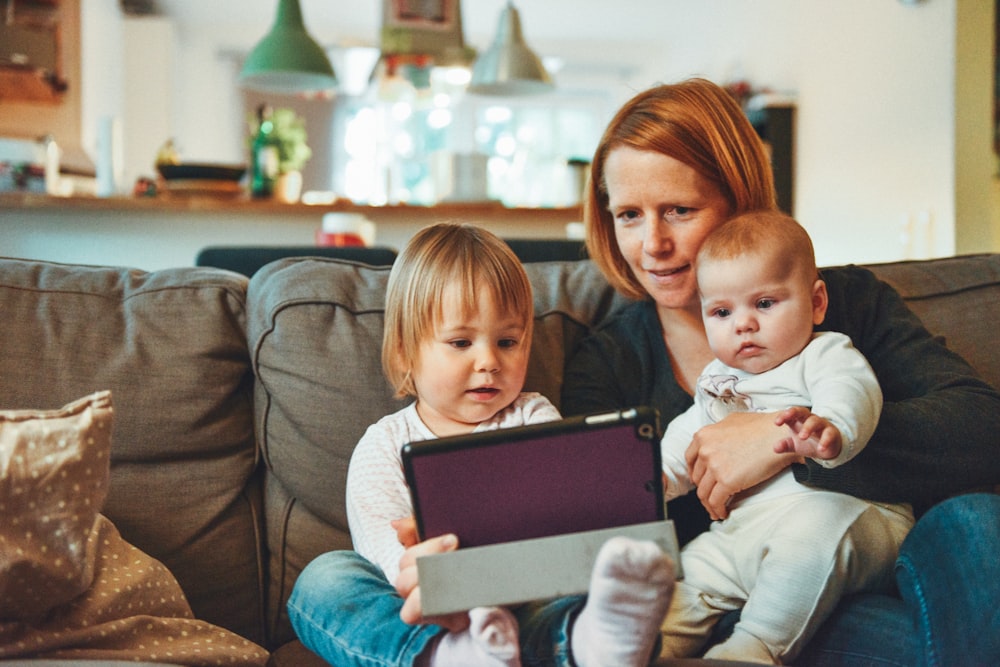
 two babies and woman sitting on sofa while holding baby and watching on tablet

Principles Revisited

Supporting families without visiting them seems anathema to early intervention in the U.S. Nevertheless, we realize that, in the RBM, it’s about providing emotional, material, and informational support to families. This support does not require us to be natural environments. We learned that in working with international implementation sites that could not see their way out of their clinics and rehab centers. It’s not where you support families: it’s how you support them. Therefore, get families online and support them by attending to the following principles:
Principles of the Routines-Based Model
All the intervention occurs between visits
Family sets the agenda
Parents are competent adults
Family consultation is how we work with families
The two-bucket principle
We provide support-based visits (McWilliam & Scott, 2001)

References

Barton, E. E., Kinder, K., Casey, A. M., & Artman, K. M. (2011). Finding your feedback fit: Strategies for designing and delivering performance feedback systems. Young Exceptional Children, 14, 29-46.
Behl, D. D., Blaiser, K., Cook, G., Barrett, T., Callow-Heusser, C., Brooks, B. M., . . . White, K. R. (2017). A multisite study evaluating the benefits of early intervention via telepractice. Infants & Young Children, 30, 147-161.
Davis, A., Hopkins, T., & Abrahams, Y. (2012). Maximizing the impact of telepractice through a multifaceted service delivery model at the Shepherd Centre, Australia. The volta review, 112, 383.
McWilliam, R. A., & Scott, S. (2001). A support approach to early intervention: A three-part framework. Infants & Young Children, 13, 55-66.
Neely, L., Rispoli, M., Gerow, S., & Hong, E. R. (2016). Preparing interventionists via telepractice in incidental teaching for children with autism. Journal of Behavioral Education, 25, 393-416.
Olsen, S., Fiechtl, B., & Rule, S. (2012). An evaluation of virtual home visits in early intervention: Feasibility of "virtual intervention". The volta review, 112, 267-281.
Tomeny, K. R. (2020). Telecoaching in early intervention: Supporting professionals and families of toddlers with or at risk for autism spectrum disorder. The University of Alabama, Tuscaloosa, AL.  
3/23/2020


[1] The feminine pronoun is used for convenience, recognizing early interventionists, like me, can be men.